
Recently I’ve gotten fascinated with a game called Werewolf – which is based a similar social deduction game “Mafia”. Players have limited information and have to talk amongst themselves to try and figure out who did what to whom, and who knew what when, before time runs out.
Category Archives: UX Design
User Experience Design
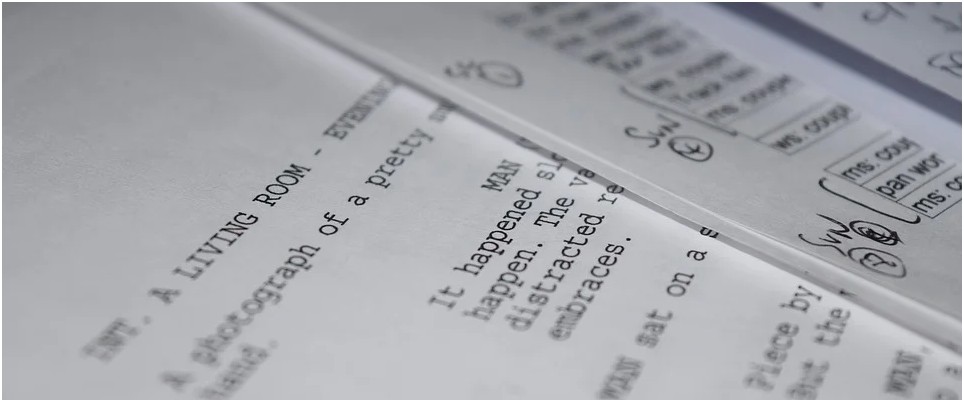
Tooling for expressive TTS
Over the last several years I’ve worked on a number of ways to make computer generated speech more expressive.
Not just a bit, but radically more so.
Continue reading Tooling for expressive TTS

NYC Ferry – Google Custom Action
A little while ago, I hacked together a custom action for the Google Assistant that would take the publicly available time tables for the NYC Ferry and answer questions about the routes and schedules.
I’ve never released it publicly. So far, I’ve just kept it for personal use as it’s often faster than pulling out my phone, loading the NYC Ferry app and navigating to the right sub-page for schedules. Voice search can be powerful for the right kinds of tasks. If you can simply ask “When’s the next boat from Dumbo to South Williamsburg?” that can flatten a lot of otherwise tedious menus.

Dragon Desktop Assistant
In 2011, I was fortunate enough to lead the design team on this Nuance / Intel partnership to develop the first intelligent assistant for ultrabooks. The result was Dragon Desktop Assistant. Here’s a pretty good demo of some of its functionality.
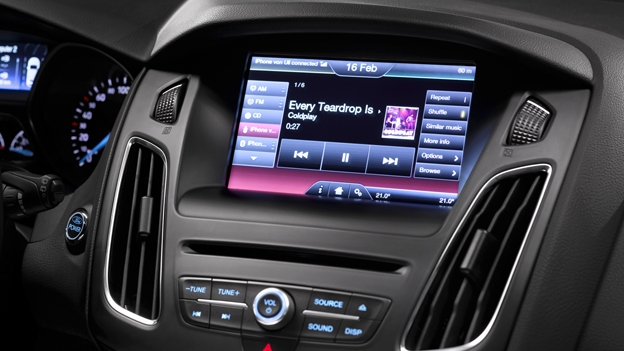
Ford Sync 2
I led the design team for Ford Sync 2. Shot this in Montreal while testing the design on a prototype. Click the image to see a video of some prototype testing I was doing in Montreal in March, 2010.

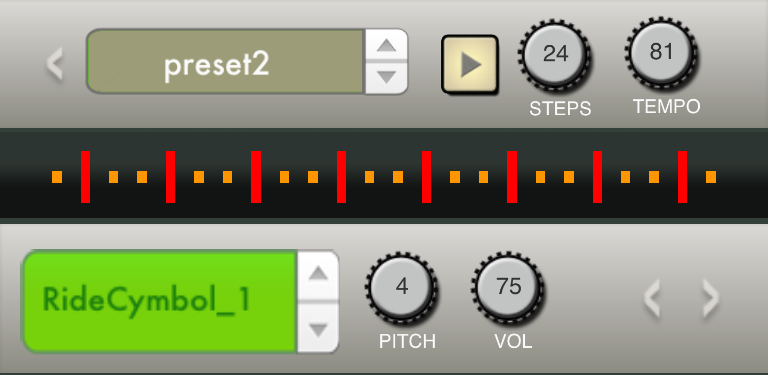
Drum Toy
Drum Toy uses an admittedly weird drum machine architecture and concept. You create basic loops using Drum Toy’s Every and Offset knobs, and then feather in the secret ingredient: Probability!
In a way, Drum Toy ‘thinks’ the way drummers do. Find the pocket, lay down the main groove and sprinkle lightly with a few tasty fills or variations here and there to keep things fresh. Drum Toy is set up to force certain beats while leaving others to just the right amount of chance. This simple mechanism yields a surprising array of personality.
Update: Feb 2018
I’ve recently created a Logic/MainStage MidiFX Scripter hack that is really useful as it combines my favorite features from DrumToy & MidiBot!
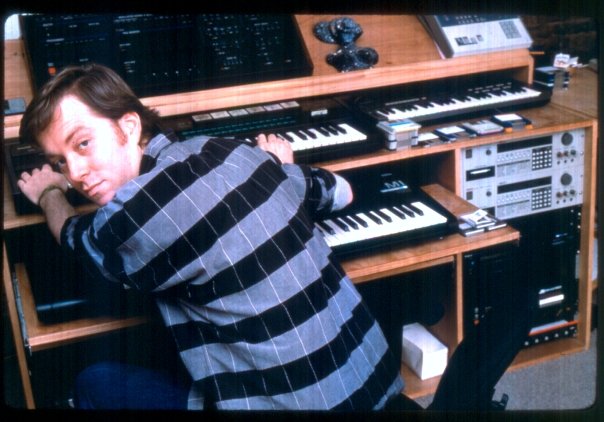
Harmonic Expansionism
The Rotator: A Realtime Harmonic MIDI Processor
“Boure”
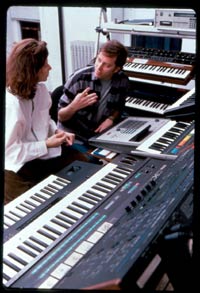 As a kid, I learned to play folk guitar during the early sixties, and I’d experimented with a number of “open tunings”. Though I knew a couple of standard tunings used for bottleneck blues and such, I didn’t take much notice until I started listening to Joni Mitchell.
So I thought, “What if you could do the same thing on keyboard?”
Continue reading Harmonic Expansionism
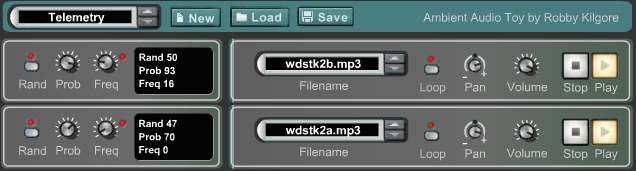
Ambient Sound Toy
Here’s an updated incarnation of an older graphic interface for creating and controlling probability-based ambient or rhythmic audio that I built in 2006-ish.
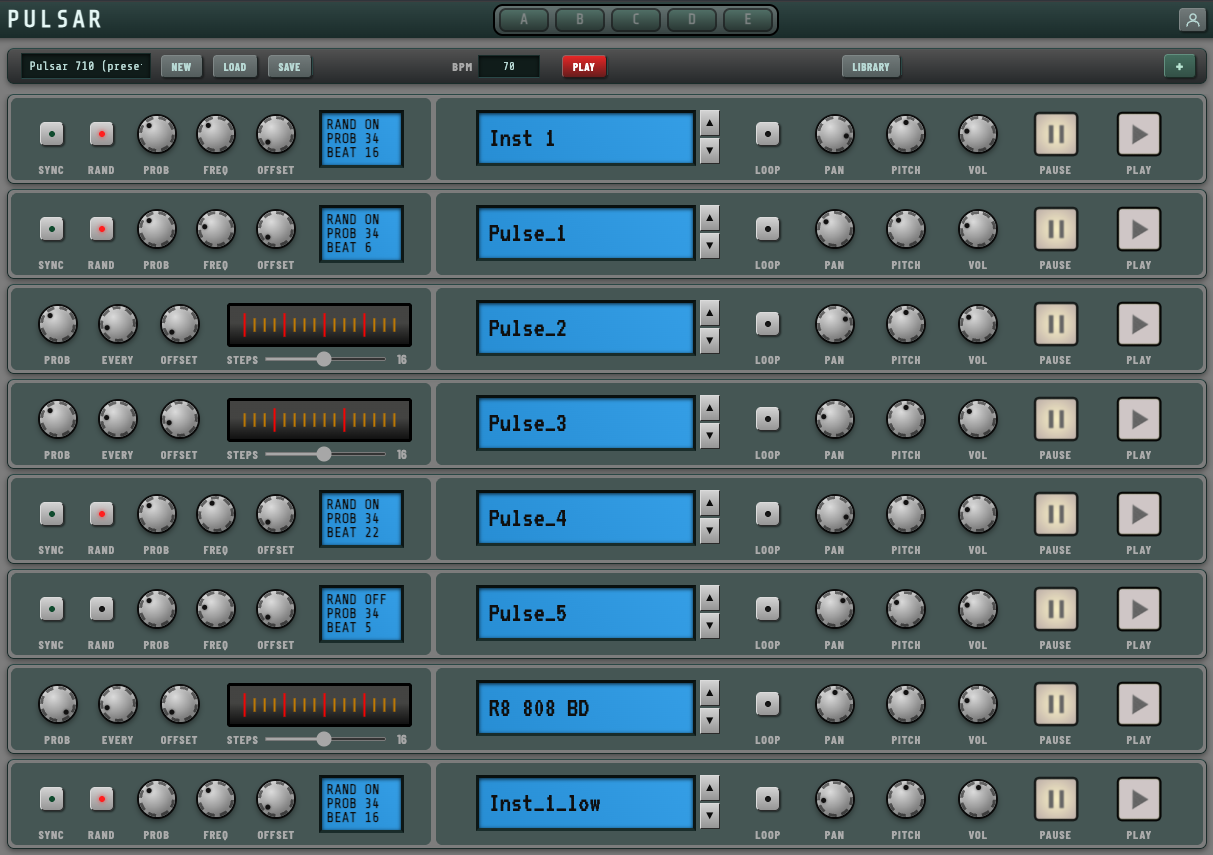
WHAT IS THIS?
PULSAR is a probabilistic sample playback machine. Each row in the rack plays one sound, triggered randomly, on a loop, or manually. Rows run independently — layer as many as you like up to 64. The sound engine runs in your browser using the Web Audio API. All sounds are sample-accurate when using Beat Sync.
At some point, I may make the desktop version of this for ambient installations. Its got multi-channel USB output and MIDI sync capabilities too. But I just haven’t packaged it up yet. One of these days…